Blog

3 Chiropractic Myths- Busted!

There are a lot of misconceptions about chiropractic care and chiropractors floating around… Today, I am going to tackle 3 of the Chiropractic Myths I hear most often:

Once you go to a chiropractor, you have to go FOREVER.
patient-adjustment

Most people seek out chiropractic care when they are in a lot of pain or have an issue they would like to resolve. Chiropractors are fantastic at taking care of low back pain, headaches, whiplash associated disorder, thoracic outlet syndrome, etc. Usually, these conditions can be taken care of with a single treatment plan combined with exercises, chiropractic adjustments, and nutrition.

But what happens then?

Once you have seen a chiropractor, you become more aware of your body and how it moves. Often, the condition that brings people into the chiropractor have been a long time coming and they don’t even remember what it’s like to truly feel good.When things are moving well, you are feeling great. This is a common awareness in chiropractic patients. These patients progress from acute care- where we target a major condition or problem- to corrective care.

Corrective care focuses on helping to identify, target, and eliminate movement patterns or postures that were behind the low back pain or headaches. This type of care can take a bit of time to work through, depending on how diligent home exercises are performed and how long the problem has been going on.

Following this, some patients elect to continue seeing their chiropractor periodically to prevent future issues and to be checked for wellness. This is the part where people tend to say that you go FOREVER. However, as humans, we are very complex machines that come into contact with all kinds of challenges from long flights, to tech neck from working on computers, to falls and athletic injuries. Many people choose to get checked periodically to ensure that they are doing well and have nothing brewing underneath the surface. But this is their choice!

Chiropractors aren’t REAL doctors.

Chiropractors undergo graduate education to achieve the degree Doctor of Chiropractic (DC). While chiropractors do not treat patients using drugs or surgery, our education is comparable to that of Medical Doctors (MD). In fact, our core studies are just about the same! Click here for a breakdown of the course requirements for DC vs MD students.

Chiropractors are trained in anatomy, physiology, biochemistry, pathology, clinical diagnosis, etc; however, our training in treatment involves learning how to adjust the spine and other joints of the body, work with soft tissues, and implement clinical nutrition.

One thing that I feel it is important to emphasize is that chiropractors are especially well trained in recognizing when pain is not coming from the joints or the spine, but from another area. For example, sometimes right shoulder blade pain is referred from a hot gallbladder. In this case, the patient is often referred to an MD, DO, or ND for further evaluation and intervention. This is especially important because many common organ conditions cause back pain, causing people to seek chiropractic care.

In conclusion, Chiropractors are REAL doctors, just not medical doctors 🙂

Chiropractic Adjustments HURT

As I mentioned above, many times pain is the main driver that causes someone to seek out chiropractic care. If you have ever had back pain, you understand that sometimes it is painful to even have your clothes touch the area that is injured. It is understandable, then, that a chiropractic adjustment may be uncomfortable in that area.

However, an adjustment is not, generally painful. I have made a point, in my education, to learn many techniques. This includes one  that uses less pressure than you would be comfortable with on your own eyelid (Did you just push on your eyelid?) as well as instrument adjusting.

When a patient is in pain, I work to make my adjustment as comfortable as possible- sometimes using cold or heat to relax the area before adjusting.

Most patients report mild to no discomfort throughout their adjustments- in fact the majority experience a sense of relief almost immediately.

What is something that you have heard about chiropractic care?

Stay tuned for more Myth-Busting about Chiropractic care!


Chiropractic Helps Low Back Pain in Pregnancy

Pregnancy is one of the most exciting and amazing experiences in a woman’s life. During pregnancy, her body changes and blossoms as it accommodates the tiny human that is being built. This process is beautiful. Somewhat uncomfortable, but beautiful. Most women, however, don’t know that chiropractic care can greatly improve some of the aches and pains commonly associated with pregnancy.

prenatal-chiropractic-patient

As a Doctor of Chiropractic, I have taken advanced training in the analysis and treatment of pregnant women. It is one of the greatest honors afforded me by my patients- the trust that I will take care of them and their growing family. The tremendous changes that a woman’s body undergoes while pregnant (and in the months directly following birth- have you ever tried to carry a car seat!?) cause altered biomechanics and stress that can result in headaches, low back pain, lack of mid back mobility with a feeling of shortness  of breath, pain into the leg(s), etc. Using the Webster technique, as well as modifying other techniques including Sacro-Occipital Technique, Applied Kinesiology, and Diversified, I apply gentle corrections to the spine and soft tissues. Women with malpositioned babies often seek chiropractic care to help balance their bodies as well- for more information on this check out my prenatal page.

Today, I came across a research article with full text available here, that outlines a study performed on pregnant women with low back pain during pregnancy. To summarize, below are the Results and Conclusions part of the abstract:

Results

52% of 115 recruited patients ‘improved’ at 1 week, 70% at 1 month, 85% at 3 months, 90% at 6 months and 88% at 1 year. There were significant reductions in NRS and Oswestry scores (p < 0.0005). Category of previous LBP episodes number at one year (p = 0.02) was related to ,improvement’ when analyzed alone, but was not strongly predictive in logistic regression. Patients with more prior LBP episodes had higher 1 year NRS scores (p = 0.013).

Conclusions

Most pregnant patients undergoing chiropractic treatment reported clinically relevant improvement at all time points. No single variable was strongly predictive of, improvement’ in the logistic regression model.

What fantastic results! Chiropractic care provides statistically significant results in the treatment of low back pain in pregnant women- including at the 1 year mark!

If you are interested in learning more about prenatal chiropractic and/or having your questions answered, please feel free to reach out to me for a consultation or referral to a provider close to you!

Helping to keep Mommas healthy is a passion of mine that I bring to Seed of Life. Stay tuned for future posts about chiropractic care and overall health…

Holiday Survival Guide

The Holidays are upon us! Thanksgiving has passed and we are welcoming the onslaught of holiday parties with Family, Food, and Cheer… Though if we are honest most of us have a love/hate relationship with the holidays.

lights-1088141_1920

Love the family time → hate how family knows how to push all the right buttons

Love the food → hate how clothes fit later

Love the cheer →  but who can be happy all the time?

Thankfully, I have devised tactics to combat this love/hate relationship to leave us with bigger smiles and (hopefully) intact waistlines after the holiday season.

Family Time

I love family meals. I love the people. I love spending time with loved ones who know all my stories and love me for them… but this is also the downfall. Many times family can’t help but bring up the embarrassing or hurtful stories in a way that is meant to be funny, but awakens some old hurt you swore was gone long ago.

After years of this, I have finally found a counter-tactic. Rather than reminiscing about days past, I come prepared with a game to play (a prize is a plus) These help to build our relationships rather than relying on past interactions.  I also bring at least one question to ask each family member- who doesn’t like to be an expert in their own topic or talk about themselves!

Food

christmas-655681_1920

The food at the holidays is nothing less than decadent.  It is entirely too easy to over-indulge. There are work parties, neighbors give cookies, family parties, friends have ugly sweater parties, and the list goes on. With all of this, our good habits from the rest of the year are often thrown out the window and we eat more cookies than we planned, drink in excess, and have just one more helping at dinner.

In past years, I have gained a rather large amount of weight over the holidays which I immediately try and banish with workouts and an endless march of salads in January.

The last 2 years I have planned ahead. When going to parties, I eat a small salad or some veggies before leaving the house. I offer to bring a dish to pass that is low in sugar and high on taste. If the meal is buffet style or appetizers only, plate food instead of grazing and always choose the smallest plate. If seated, put your fork down between bites! Cookies… I haven’t found anything too fool-proof here. The variety is my Achilles heel- I want to try them all! What I attempt to do is take only 1-2 cookies and split them with my husband.

Holiday drinks are often high in sugar and very rich, so I always aim for a glass of dry wine that is easier to sip than drink or a fill a glass with ice before adding any cocktail. Staying hydrated is also key- always have a glass of water at your place in addition to your drink.

Moderation in all things is the goal- with food and drink, you get to have some of the decadence but can keep a modicum of control over consumption.

Holiday Cheer

I am an introvert.  A Meyer Brigg INFJ. Holiday cheer is uplifting and exciting. It provides an opportunity to celebrate and connect with people. It also leaves me feeling drained and wanting to crawl under a rock. As an introvert, self care is incredibly important, so I make sure to sleep enough, mediate regularly, use a gratitude journal, regular adjustments, and remind myself that it is OK to come late or leave a party early.

Holiday cheer can also be a financial burden with gift exchanges and lots of eating out. Understanding what is within budget and what is affordable can be a downer, but will ultimately make holidays more gratifying in the end. No one likes to go into debt for the holidays. Amongst my friends and family, we use white elephant exchanges, games, and handmade gifts to keep the costs down on entertainment.

The take home on cheer is to understand your own limits and respect them. Whether you are an introvert like me- who needs to recover after being social- or an extrovert who thrives on community, it is important to stay within your boundaries.

Who doesn’t love the holidays?! It is a time when we celebrate with loved ones, new friends, and old. By maintaining good practices with family, food, and merry-making- we can ensure that we are healthier at the end of our holidays both mentally and physically.

What helps you survive the holidays?


Gratitude… More than just a holiday?

It is upon us! Thanksgiving is in just a couple of short days and, while the original historical background of Thanksgiving is controversial, it remains my favorite holiday. If we look at Thanksgiving in completely modern terms it has become a holiday of excess. Too much food. Shopping instead of family. Capitalism. Overall, it has been a holiday celebrating successful harvest, has been called a holiday commemorating the beginning of the persecution of the Native Americans, has been about a giant rock on the East Coast, getting great deals on shopping, gluttony, and- I am going to propose- Gratitude.

sol-1381860_1920

Gratitude is the main reason Thanksgiving is my favorite holiday. It is a time for family and friends to gather together over a meal (modest or grand) and be grateful for the blessings of the year and for each other. Gratitude is a choice and by choosing to express it, we improve ourselves.

I was reading an article in the New York times about gratitude that cited studies demonstrating that people are genuinely happier when they choose gratitude. Not to mention that the brain, when studied with fMRI actually fires differently for pride and gratitude than with anger or jealousy. This indicates that we have the ability to use neuroplasticity to change our brains to be wired for gratitude.

What could this mean for us!? As individuals, choosing to be thankful and positive means enriching our own lives. As members of society, making this same choice means that those around us benefit from our gratitude. When we elevate the positive, we tip the balance in favor of light.

As the great Martin Luther King, Jr said, “Darkness cannot drive out darkness; only light can do that. Hate cannot drive out hate; only love can do that.”

It can be difficult to choose gratitude when things seem dark or hard. I mentioned on Facebook last week, one way to choose gratitude is to remind ourselves. You can use a gratitude journal where you list 3 things you are grateful for each morning. (I like to enhance this with 3 things that I am excited about and also 1 thing I will do for myself that day) Sometimes this is incredibly hard and I fall back on some classic things to be grateful for like family, shelter, education, my silly cats. Other times I am truly moved by the world around me into a place of profound gratitude and I can’t stop at 3. My planner also has a column for “Good Things That Happened” AKA Gratitude!!! If structured journaling isn’t your thing, try creating a list like this that contains things that are positive from your life/week. One of the benefits of writing it down is this: when times are the hardest or things seem to be the darkest, you can look back and see all that you have to be grateful for.

Choosing gratitude is more than a holiday, though Thanksgiving is an excellent excuse to start your practice. If you happen to be at my house for Thanksgiving, on the table is a sheet of brown paper and crayons instead of place mats. This provides an excellent excuse ample opportunity to make hand turkeys or to write down what you have to be grateful for.

I am thankful for so many things and people in my life- I am even thankful for you (whether we have met or not).

“Food Matters” by Mark Bittman

Did you miss our book club meeting?

vegetable-plate-1179401_1920.jpg

Below, you can find Dr. Samelak’s review of Food Matters!

I really enjoyed reading Food Matters. Mark Bittman provides readers with an easy to understand discussion on how our eating habits impact our bodies and the environment. Most of the time, people get swept away by fad diets and what is being discussed on the latest talk shows. It is too easy to forget the basics.

Take home points:

  • We eat too many processed foods instead of whole foods.
  • On our planet- and especially in our country- we eat too many animal products to be sustainable
  • “If we each ate the equivalent of 3 fewer cheeseburgers per week, we’s cancel out the effects of all the SUV’s in the country”
  • The dietary recommendations of the food pyramid and “My Plate” are not sustainable and rely too much on processed sugars
  • With preparation it is possible to replace a lot of our processed foods with better options
    • Bittman provides some excellent recipes regarding this in the back of his book and does a great job with a sample menu
  • It is important to understand that the amount of animal products we consume directly effects greenhouse gases
  • Work on portion sizes!
    • Proteins and fats are nutrient dense and should be eaten in small portions
    • Veggies are nutrient poor and should be eaten in large quantities

Food for thought:

By eating locally and voting with your spending, it is possible to help improve our environment… all the while improving your overall health. When you eat cleanly (read as much organic, minimally processed foods as possible) weight loss is a side effect.

Do you have a favorite recipe that is in line with Food Matters? Please share it below!

Are walkers bad for my Baby? What about other upright toys?

Quite often I have friends and patients who ask me about walkers, exersaucers, and Bumbo seats (along with a huge list of other infant toys). There is a lot of confusing information on the internet regarding these and some of it is very misleading from manufacturers. I hope that here I can clarify some of the information and give you some facts.

The place to begin is normal child development. When a baby is born, they have no curves in their spine and they have no understanding of the physical world. These things are learned and skills are earned through experience and exploration. Motor and mental development are often broken down into “milestones” which are a series of behaviors and skills that we expect children to have at different ages.

baby-84552_1920.jpg

Spinal development is completely formed through activities. Tummy time causes the little one to lift their head up, forming the cervical (neck) curve. The curve in the lumbar spine (low back) is formed when the child begins to rock and crawl. The muscles and bones of the spine develop in response to these activities and the basis of the adult spine is formed.

The same activities that help to form the curves in the spine stimulate the brain and help your child develop a sense of where they are in space (proprioception). Crawling, scooting, pulling up, walking, and tummy time help in vestibular (balance) and sensory development. Movement stimulates a circuit called the Reticular Activating System which links motion to the cerebellum and helps the brain to learn posture and balance (and a whole lot more!).

Walkers:

FullSizeRender (5).jpg

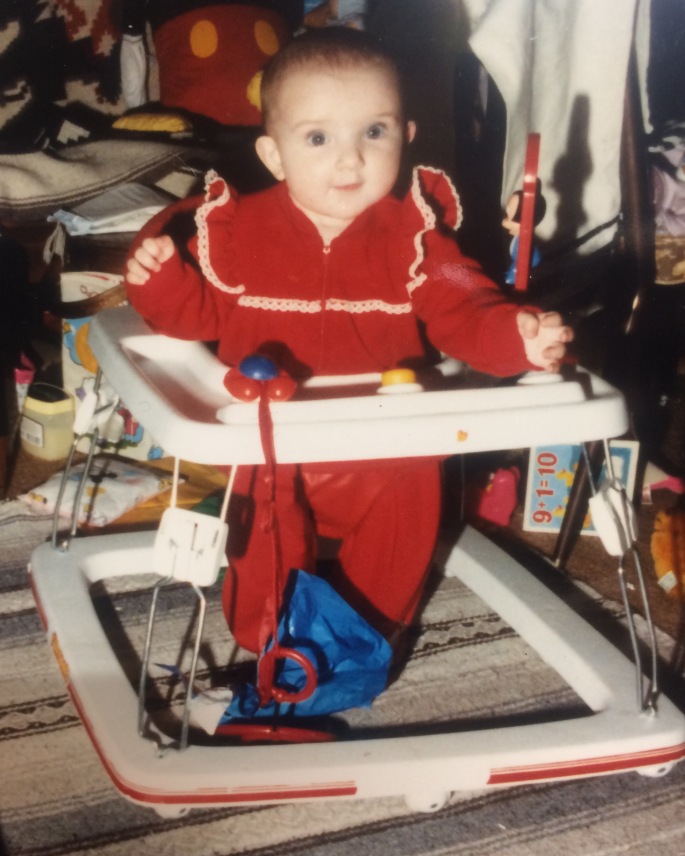
Walkers are one of the most dangerous babysitters. A 2006 study looked at ER data from 1991-2001 and found 197,200 ER visits related to walkers. This study does not take into account those who saw a pediatrician, other health care practitioner, or stayed home for self-care. Walkers allow little ones to move quickly and often they can tip when they encounter the edge of a rug, door sill, or staircase.

Actual physical injuries aside, it is important to take into account the mental and motor developmental delays associated with walkers. As we mentioned above, many skills are dependent upon motion and experiencing the environment. It is easy to see how a parent may think that a walker is a great way for their little one to experience the world. However, this is a false environment. In a walker, children cannot see their feet which changes how the brain develops proprioception, children do not have to learn balance, and their future gait (walking) patterns may be affected.

In 1999, a study was performed with 109 infants where some were placed in a walker and others were allowed to play on the ground. By a landslide, the walker infants sat, crawled, and walked later than the other group. It is also important to note that the walker group also scored lower on the Bayley scales of mental and motor development.

In 2004, Canada banned baby walkers.

Upright Bouncers:

baby-84549_1920

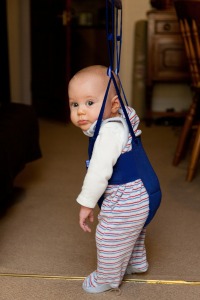
Upright bouncers like the Jolly Jumper are very hard on the developing spine of the infant. The stress of being held prematurely in an upright position, when the bones and muscles have not developed the proper strength can damage the infant spine. Spondylolisthesis can occur in the lumbar spines of infants in these types of devices from the repetitive stresses delivered through an undeveloped spine. Spondylolisthesis occurs when the front part of the vertebra (which stacks) is separated from the posterior elements which surround the spinal cord and most often occurs at the lowest bone in the lumbar spine.


Exersaucers and Bumbo chairs:

These upright devices promote abnormal postures and can lead to the altered formation of the curves of the spine. For example, when an infant is placed in a Bumbo chair, their pelvis often tips backward, thrusting the ribs forward, and promoting anterior head carriage. This is a reversal of the curves we see in a normal spine- indicating that increased spinal stress is present when children sit in these positions.

While the Exersaucer is much safer (less likely to tip) than a Walker, it still promotes weight-bearing through the spine in an abnormal and premature way and should be used with caution.

What is the take home? Children need to experience their environment in order to learn. It is essential to have a lot of exploration time for our infants and little ones. The development of their brains and bodies depend upon it. As a Doctor of Chiropractic, I am committed to sharing knowledge with parents so that they can  make informed decisions regarding their children.

References:

http://consults.blogs.nytimes.com/2010/02/22/the-dangers-of-baby-walkers/?_r=0

https://www.ncbi.nlm.nih.gov/pubmed/10533994

https://www.ncbi.nlm.nih.gov/pubmed/16510623

http://articles.chicagotribune.com/2012-03-15/health/ct-met-bumbo-posture-20120315_1_physical-therapists-developmental-benefits-babies

http://pathwaystofamilywellness.org/The-Outer-Womb/maximizing-infant-development.html

The Place Between Breaths

The past week has been a very stressful one for me, personally. I am having a lot of things going on in my family and have been relying heavily upon meditation, journaling, and exercise to elevate mood and keep myself centered. These are techniques learned through trial and error and through many different teachers that have come to be a solid basis of self-support for me.

This would be an incredibly long blog post if I ran through all three, so we will zero in on meditation today.

****Disclaimer****
I have never trained formally in meditation, but I do practice regularly. Scroll all the way to the end for sources of additional information on meditation and resources to help you find your own path.

img_2803

Meditation is incredibly easy in concept and difficult in practice. It comes in different forms. It can be guided. It can be mediated by the inhale. It can focus on the exhale. It can even be focused around the space in between the breath- that little moment between inhalation and exhalation where stillness takes place. Below I am outlining 3 of my favorite kinds of meditation techniques.

Self-guided meditation (envisioning your greatest self)

I learned about this type of meditation at the International Chiropractic Pediatric Association’s Freedomfest in 2014. Dr. Joe Dispenza spoke about the power of the brain and about his book, You Are The Placebo. I am about 1/3 of the way through this book and am learning a lot about how we make our thoughts become a reality. But I digress…

Each morning, I take 9 minutes (the time between my alarm and my snooze) and meditate. Before my feet touch the ground. Before I check my email. Before I let the world take me away from the peace of rest. I meditate. I begin by remembering back to a time when I was truly, completely, sincerely joyful down into and out from the core of my being. Once I have that moment, I allow that feeling to surge through my body and make its way all the way from the crown of my head to the tips of my fingers and toes. Thus embraced in a moment of pure joy, I picture my physical self in total fitness. My best self. I choose the facial expression, the shine of my hair, the tone of my muscles- you get the picture. And I let these two things come together. The Joy and the Best Physical Self.

This lets me step backward and see myself as I truly am.

Some days this is incredibly easy and I can slip right into that state of joy and gratitude and wellness. Other days I have just found the joyful moment when the alarm sounds. No matter what, I accept what my practice was and take it forward into the activities of the day.

Meditation with Outside Guidance

A couple of years ago, I did a series with Deepak Chopra and Oprah about mindfulness. It was a series of guided meditations and journaling from Deepak. I had never done meditation guided by another person before- and have discovered that it is a great way for me to get to meditate when I am having a hard time finding my own quiet. Deepak has a ton of meditations (even on Spotify and Pandora) that you can listen to and follow along. He walks you through your meditation from what to do with your feet and hands to your breathing. It is incredibly helpful, especially for the crazy busy type A person. When I am having trouble stepping out of my life and into my heart space, I turn to  Deepak.

“To make the right choices in life, you have to get in touch with your soul. To do this, you need to experience solitudem which most people are afraid of because in the silence you hear the truth and know the solutions.”

– Deepak Chopra

Silent, Breath Focused, Meditation

I am not really sure how to describe this one. Breath focused meditation is exactly what it sounds like. You are aiming to find stillness with focus on nothing except the breath- be it the inhale, the exhale, or the pause. This is not to say that there will be no thoughts in your head and that you have to reach a place where you are totally blank. It means, that we acknowledge the thought and let it pass without our focus. I generally prefer to focus on the space in between the breath because otherwise I find myself trying to control the tide of my breathing. (Type A much?) I have found that this type of meditation does not at all come easily to me and that I do best with it after yoga or a good workout. As though I have to get out the physical energy before I can bring my focus internally. I have also found that practicing in a group/structured setting helps me with breath meditation. To improve my skills in this, I have visited many Buddhist temples for meditation practice.

I still find that I do my best meditation in nature (see the photo at the top of this post). Something about the stillness of the forest makes it easier for me to find my own stillness.

What all of this boils down to is this: We as humans have an incredibly hectic and chaotic way of life. We focus so much external energy that we often deplete ourselves. There are many ways to take care of yourself. Some people schedule resort vacations where they can recharge their batteries with sun, sand, and tropical drinks. Some people work out. Some people camp and hike. I would suggest, though, that we take a second to assess ourselves and make sure that we are taking care of ourselves routinely. Meditation is an excellent way to stay centered and focused.

For years my mom told me that I needed to meditate or at least take quiet time for myself. I brushed her off and coped in different ways. It wasn’t until I was sitting on the floor after work one day crying and feeling so far away from myself that I began to pursue meditation as a technique to come home to me. Now, my husband will sometimes look at me concerned and say, “Have you been meditating lately? You don’t seem like yourself.”

I hope you find something of use in this post that you can apply to your life- or even that it inspires you to research another form of self empowerment and fulfillment. If you want to chat about it or learn more about any of the practices that I do, please feel free to contact me through my website!

Resources:

Dr. Joe Dispenza‘s webpage where you can see his books. I also recommend following him on Facebook!

Some tips on meditation for beginners. They broke this down a lot more succinctly than I could!

Bold Tranquility is a Yoga Nidra meditation designed for women. I have had many patients rave about her work!

Deepak Chopra‘s website for a 21 day meditation experience (I love just about everything he does…)

So many more resources are out there! What is your favorite meditation practice or resource?


Don’t Quit.

img_31681This morning the last thing I wanted to do was put on my running shoes and hot the trails…but I did anyway.

Last night I went to an event at 7 Hills Running Shop to listen to Gina Lucrezi from Trail Sisters. She spoke to us about building community through running in our area. She spoke about camaraderie, empowerment, motivation, and safety. All aspects that help to build community and help to bring us all up together. Needless to say, I left very motivated to run and to build community- to be better.

When I got home, my husband and I were talking about losing our mojo. We both used to be pretty athletic- me with swimming and water polo and Robin with running. Over the years, though, we let work, school, and that word “busy” get in the way. We have stayed fit and do a race or two a year… but somewhere along the way we lost the mojo. We lost the hard core, run and sweat because it feels so good. And it is a hard thing to get back.

So. Don’t quit.

Find what makes you happy in fitness. Maybe it’s swim, bike, run like me. Maybe it is walking your dog or Zumba. Lift heavy things or bend wrenches. Whatever it is, find a buddy to join you and commit to each other. Use camaraderie to empower and motivate each other to push your goals.

Gina was incredibly inspiring to me last night, and I am on my way to getting my workout back.

What about you?

Do you need help to get started?

What gets you out and moving?

Let us know in the comments!

Make the World Your Gym

A very influential mentor to me, Dr. Kathy Dooley, has often said that it is important to make the world your gym. A chiropractor and educator in New York, Dr. Dooley has inspired me to push my limits and to “get assessed, get corrected” as she says. Her transparency in her blogging and in her life has helped me to realize that we have time for the things that matter to us, even if you have to be creative about it. For example… It is entirely too easy to say that there is no time to go to a brick and mortar gym, and what we need to realize is that the world around you can be the gym.

When you are making your choices on where to park, or if you should just walk to the store instead, realize that you are influencing your health. By parking further out. By refusing to use the escalator and using the stairs instead. By playing on the playground with your kids instead of sitting on a bench- you are making health choices. These have an appreciably small time difference from what you would normally be doing and can have an appreciably large impact upon your health.

Most of us spend too much time at a desk or on the computer, myself included, but I am inspired by the posts I see from Dr. Dooley and so I have started getting up more and moving more than I have in the past.

What can you do to get moving?

  • Set a timer at your desk and each hour spend 10 minutes walking or going through ranges of motion.
  • Choose the stairs- not the escalator or elevator.
  • When possible, walk or bike instead of driving.
  • Start your day with motion- whether it is a morning walk with the dog or some yoga.
  • Join a club that gets you out of your seat and out doing something active.
  • Swap out your traditional desk chair for an exercise ball.
  • Ditch the evening TV show for a sunset walk with a friend or partner.
  • Dance. Anywhere. Everywhere.dance-674752_1280

What are things that get you up and moving? Please share your ideas in the comment section, below!

Chiropractic Care for Kids

Wait… You adjust kids?

ethan

This is one of the questions I get most often in practice. People are more and more accepting of chiropractic for adults and conditions like headaches and low back pain. In fact, statistically, chiropractic is a top treatment for these things. However, it seems that people are taken aback at the idea of children getting adjusted.

Let me tell you a little bit about pediatric chiropractic.

Why would a child or infant need an adjustment?

Birth is a traumatic process. When you think about it, the last days and weeks of pregnancy the baby does not grow very much, most of what is occurring at this point is development of the lungs and other organs. This means that the baby is tucked into a little ball inside of mom. Then, when labor happens, they are pushed out through a small hole and someone grabs their head and pulls them out. If you have questions, try watching a video of a C-Section.  Often times the birth process causes the upper neck or the tailbone to be subluxated, causing nerve interference. Some more extreme cases result in shoulder dystocia or torticollis.

Subluxations from birth can cause issues with many things such as the latch in breast feeding. The baby’s face may appear asymmetrical or their head always tipped to one side. Others are very subtle and may result in colic, difficulty sleeping, etc. Pediatricians are not trained to evaluate the spine for the subluxation, so it is recommended that parents take their children to a chiropractor to be checked.

As children learn to crawl and walk, they fall upwards of 25 times per day. It is important for them to be checked regularly at this time to ensure that they do not develop subluxations from these falls. The trips and tumbles of childhood often result in muscle tension and imbalance in the spine. Many parents bring their children to be checked on a regular basis during the toddler years. Then child and adolescent sports throw yet another variable into the mix!

How does a Chiropractor check a child?

When I evaluate an infant or child for subluxation, I take a history of the child from pregnancy through present to learn as much as I can about their live- down to food preferences and developmental milestones. In my exam, I check all of the little one’s reflexes and evaluate ranges of motion and balance in the body. The amount of pressure that is used both in evaluation and adjustment is less than you would be comfortable with on your own eyelid. Many babies sleep through the whole process!

What is a pediatric adjustment like?

Pediatric and infant adjustments are very gentle and, like the evaluation, many infants sleep through them. Using gentle pressures and muscle stretches, I restore normal motion to the bones and restore balance to the muscles. Sometimes, I will ask the parents to assist by laying their child on their stomach or holding them while they are adjusted.

Toddler adjustments are always fun to watch. Many children enjoy laying on the table to be adjusted and relax for the whole thing, while others play on the floor and get checked on the move. I always feel that it is important to make sure that kids are comfortable and engaged in their adjustment, so I meet them on their level.

Adjusting little ones is vastly different from adjusting adults. The pace is much slower and it often looks like playing to onlookers.

How do I know if my child needs to be checked by a Doctor of Chiropractic?

Many parents bring their children in to be checked when they exhibit the following symptoms:

  • Spinal or facial asymmetry
  • Difficult latch in breast feeding
  • Colic
  • Reflux
  • Delayed or absent milestones
  • Ear pulling
  • Chronic ear infections
  • Sleep issues
  • Bedwetting
  • Trips and falls

It is important to understand that chiropractors do not treat colic, reflux, ear infections, or other medical conditions. However, interference in the nervous system from subluxations can present in these ways. By restoring motion in the spine and removing the interference, the body has the opportunity to heal on its own.

Looking for more information? Check out ICPA4kids.org or contact our office at SeedOfLifeChiro.com