

Masks- The New Fashion Accessory

Mask wearing has become more common and even required in some areas. I don’t know about you, but I have them in many colors, styles, and probably most importantly kinds of ties. Some of you are sewists who have made masks by the dozens for friends, family, donation, or sale.
We are being encouraged to wear them to slow the spread of Covid19 and help to keep each other safe. Like most things, masks come with some trade-offs that it is important to know about.
Mask wearing can be linked to increased anxiety as well as a buildup of CO2 in our bodies.
Anxiety

Wearing a mask changes breathing dynamics. Breathing through a mask- especially a thicker cloth mask or N95 mask can feel difficult. The additional effort to breathe can trigger anxiety in those prone to panic attacks. Being able to slow and take more efficient breaths can be helpful in managing this trigger. For decades, healthcare workers have managed to adapt to breathing through different kinds of masks- we can too! Skip to the breathing section of this blog if you would like some tips on breath work.
Hypercapnia- Too Much CO2
What most of you have probably noticed is that you are fatigued after wearing a mask for more than a few minutes. You might find yourself gasping for air when you take it off. Or yawning while you wear it. Your cheeks may be rosy or flushed. Sometimes you might have a headache and aren’t sure if it is from the ties behind your neck or ears.
In more extreme cases you may notice that your pulse is bounding, a sense of confusion, premature heartbeats, muscle twitches, dyspnea (shortness of breath), and increased blood pressure. All of these symptoms are known as hypercapnia. Wearing a mask means that we are re-breathing our own exhalation- increasing the amount of Carbon Dioxide that we are breathing.
During normal respiration, you breathe in oxygen rich air and expel carbon dioxide on your exhale. The lungs have an exchange system with your blood to keep this pattern going. When we wear a mask, the amount of CO2 that we breathe in is higher- known as hypoventilation. This leads to a condition called respiratory acidosis.
The human body is a brilliant machine and works diligently to correct the acidosis by calling on the kidneys to hang onto or retain alkali. This is a buffering system to aid the body in times of stress. It is not a long term solution.
It is vital for us to support our oxygenation through breathwork at this time to help our bodies stay in balance. I have added daily breathing practice to my routine to help counteract many hours of mask-wearing in my office.
Breathing Balances our Oxygenation
Breathwork helps to improve our capacity to oxygenate. It helps us to tap into our rest and digest (parasympathetic) nervous system. AKA breathing helps with stress management!!! Breathing helps to keep our cells nourished and our ribs moving. It benefits so many vital parts of our bodies.
Simple Steps to Start Breathing
Always begin by making sure that you are in a safe space for breath work and relaxation where you can take your mask off. I like to incorporate a quick breathing practice right in my car after leaving work or the grocery store.
There are many breathing teachers and techniques- even professionals like Naturopaths who provide biofeedback to help you find your best breathing potential. However, there are simple things you can try at home to start improving your breathing.
Positions for Breathing

Seated on the floor you may choose to put a cushion under your bottom to raise yourself up a few inches. This could be a folded blanket, a meditation cushion, or a yoga bolster. Sit criss-cross applesauce and, again, stack your rib cage over your pelvis and tuck in your chin. Place your hands palms up on your knees.
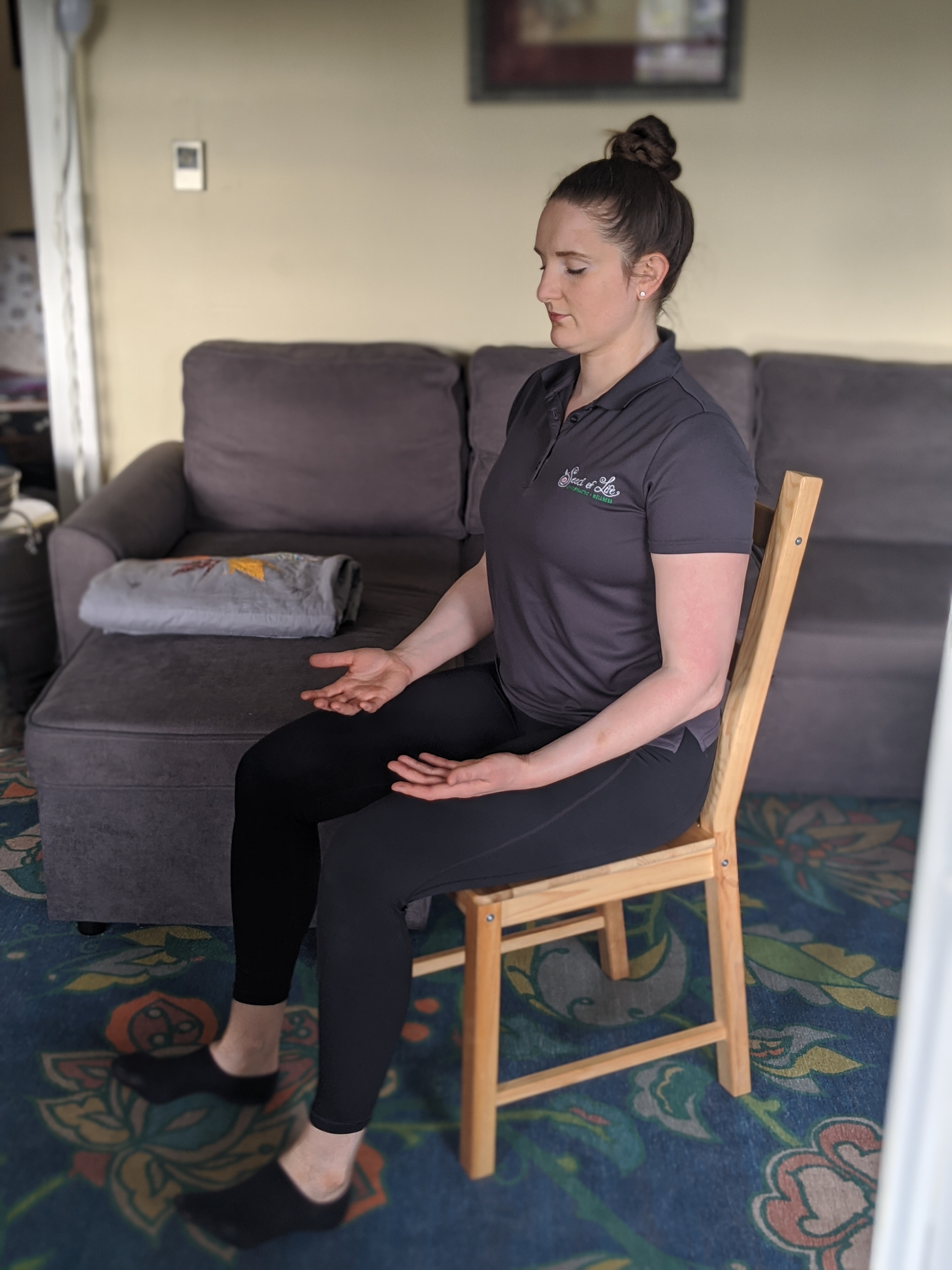
Seated in a chair with your sit bones in contact with the chair surface. Stack your rib cage over your pelvis and tuck in your chin. Ground your heels into the floor. Place your hands, palms up, in your lap.
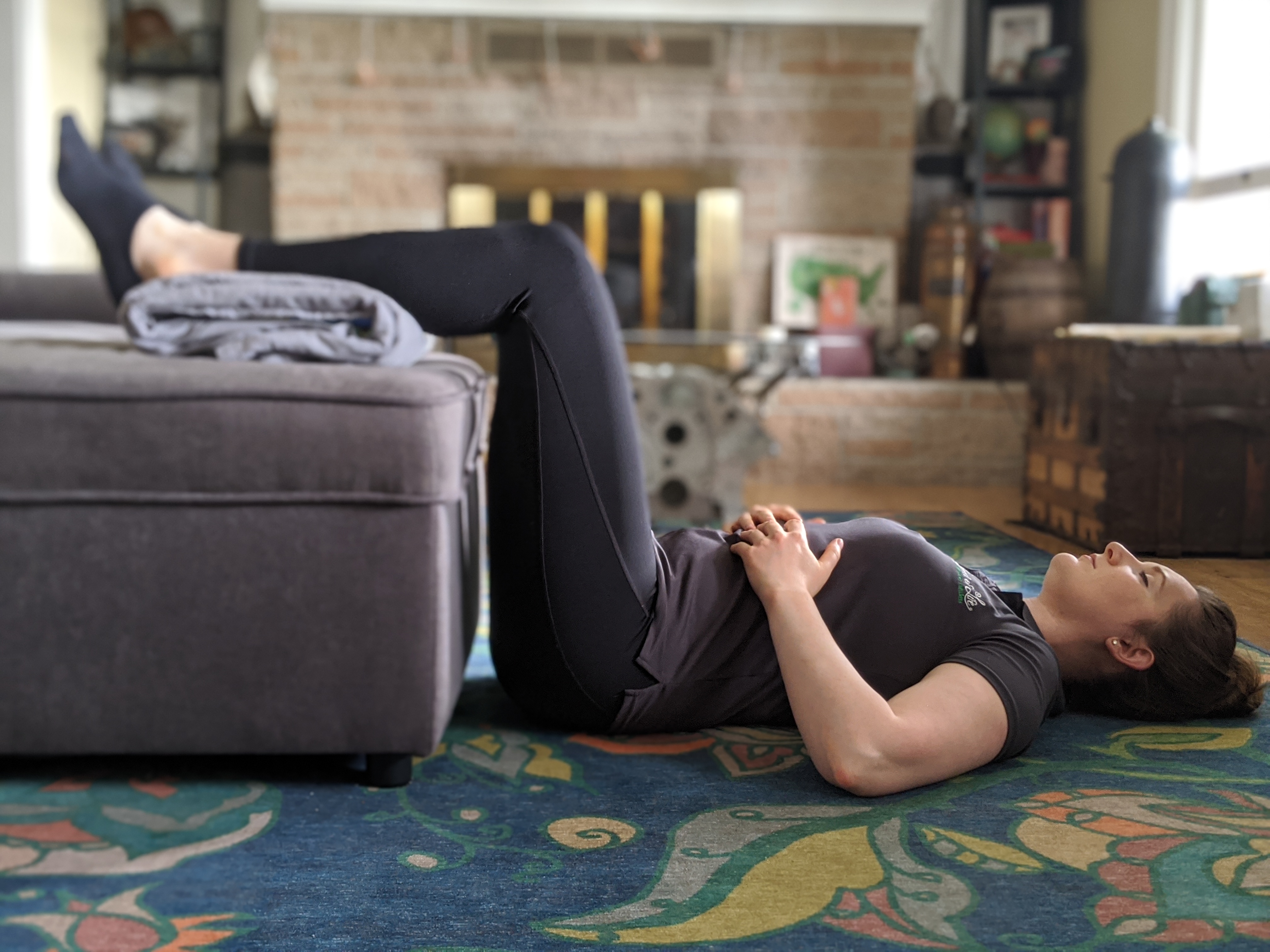
Supine (on your spine) is my favorite. I like to find a 90/90 position where my heels are resting on the couch or a chair, knees and hips bent at 90 degrees. Hands may be at your sides, palms up or you can rest your hands, palms down, on your rib cage to tune in to your breathing patterns. You should feel your spine relax in this position.
Breathing Patterns
There are many strategies for breathing and even apps that help you to breathe rhythmically- which helps to stimulate rest and relaxation. Some of my favorites include box breathing and prolonged exhalation.
Box breathing is breathing on a 4 or 5 count. Inhale for 4, hold your breath for 4, exhale for 4, and hold for 4. Repeat this for a minimum of 4 cycles.
Prolonged exhalation breathing works on training the exhalation- a great way to calm your nervous system. It is best to use a timer for this type of breathing and work to expand your range. A general rule of thumb is to plan your exhalation to be twice as long as your inhale. I started with breathing in for 5 seconds and out for 10- for a minimum of 5 minutes.
Types of Breathing
Improving your style of breathing is valuable as well. Check out the breathing types below and see where you fall.
Many people are chest breathers. This means that they breathe by using their neck and chest muscles and you can see their chest rise and fall with each breath. Chest breathing turns on the fight or flight response. This type of breathing is more like panting and is not efficient.
Belly breathers use their diaphragm, this is most common in trained singers. This type of breathing is more functional and helps to tap into the parasympathetic nervous system. Here, you will see the belly rise with each inhalation and drop with the exhale.
Functional breathing engages not just the diaphragm, but the entire rib cage. In ideal breathing patterns, the ribs will expand in 360 degrees, raising like the handle on a bucket. The diaphragm is engaged, and even the pelvis opens on the inhale. This type of breathing is most easily seen in children. It can be trained using breathing drills and exercises.
Some of my favorite exercises for breathing include:
Lewitt
Dead Bug
Supine 90/90
Straw Breathing

Tips for Mask Wearing:
- Make sure that your mask is clean or has a new filter paper in it.
- Wear your mask only when you must- this means you need not wear it in your car when driving.
- Don’t hesitate to take a “breathing break” when you have to wear a mask for an extended period of time. Find a safe space or step outside then take at least 5 deep breaths.
- Be sure that you are not touching your face or mask to avoid spreading any germs.
- Follow CDC guidelines for cleaning your mask appropriately between uses.
As always, this blog is intended for educational purposes only. Please consult with your Chiropractor, PT, or Primary Care Physician to determine what steps may be right for you.
Dr. Samelak is a Family Wellness Chiropractor in Seattle, WA. She loves serving families and helping them to reach their greatest potential. If you are looking for a Chiropractor near you, please reach out to us for help!
Follow us on Facebook or Instagram @seedoflifechiro
Resources:
- http://thebetteroxygenmask.com/harmful-effects-of-rebreathing-carbon-dioxide-co2/
- https://en.wikipedia.org/wiki/Hypercapnia
- Textbook of Medical Physiology, 11th Edition, Guyton and Hall 2006



 Amber is a professional trifecta, seeing clients as a functional nutritionist, massage therapist, and personal trainer. Her passion is figuring out the cause of imbalances that her clients come in with. After decreasing her own depression and regulating hypoglycemia through food choices and targeted supplements, her focus is helping others find optimal mood balance and decrease symptoms related to diabetes and other blood sugar imbalances. Amber lives in the Queen Anne neighborhood of Seattle with her husband, Steve and adorable pittie, Lucy. In her spare time she enjoys hiking and reading, and is a die-hard Gryffindor.



 “Human tissue is phenomenal stuff. When you make small changes in your movement patterns, you nudge yourself down a new physiological path. The body works to tear down old or underused tissue every day, and builds up tissues that are in greatest demand. The body continuously adapts to whatever you are doing now. Changing your habits will change your life!”- Katy Bowman
 Massage during pregnancy may increase how much loving touch mothers provide their infants. Touch is hugely important for human development. Even with all our other physical needs met, without touch, babies fail to thrive. Women who receive compassionate touch (such as through massage) during their pregnancy and labor go on to touch their infants more, in a more nurturing way. This creates more security and attachment for the baby, versus babies who are touched less and can be more aggressive and withdrawn.
 Lize Williams is a Licensed Massage Therapist whose work focuses on the strains of bearing and raising children. After having her own daughter she realized just how hard engaging in self-care can be for new mothers, so she founded Motherhood Massage, a house-call based massage practice designed to reduce the barriers to self-care for mothers, mothers-to-be, and other caregivers. She recognizes that amongst all the joy, motherhood can also be challenging and isolating, and works to help her clients feel more connected to themselves, their families, and their world through the healing power of touch. Her work combines treatment and relaxation, to help soothe and strengthen her clients’ bodies and minds. The perinatal period is rife with changes and challenges, and Lize views her work as a wholistic support for her clients, helping them with face whatever the journey into parenthood is throwing their way. She is a certified MotherTouch Bodywork Professional and has studied under Leslie Stager.
 Fooducate





 While we don’t pretend that we have any control over a labor or delivery experience or outcome, our goal is to constantly be adding tools to your toolbox. Each squat, each interval and guided visualization, each time you practice your breathing you are adding these tools.



 Your Chiropractic Home in the Heart of Fremont